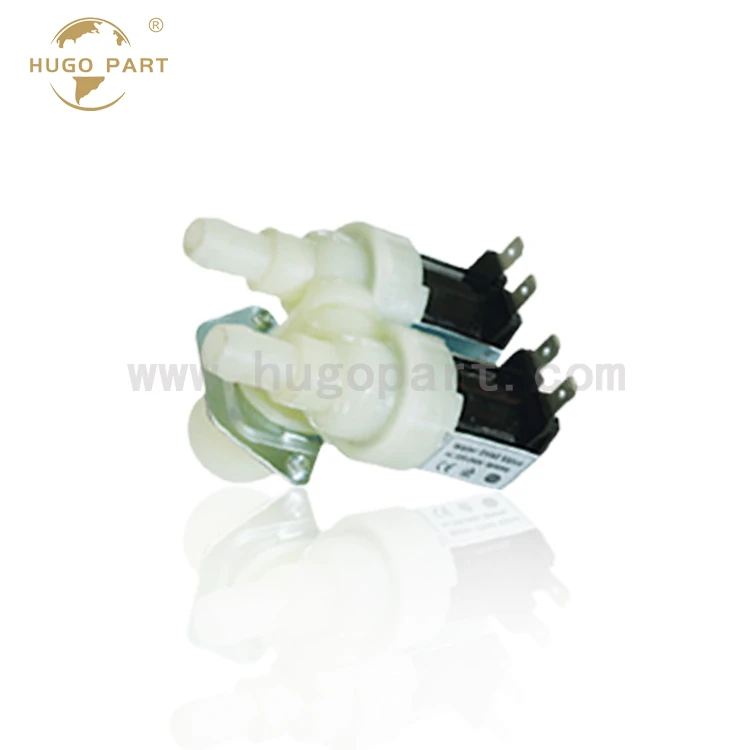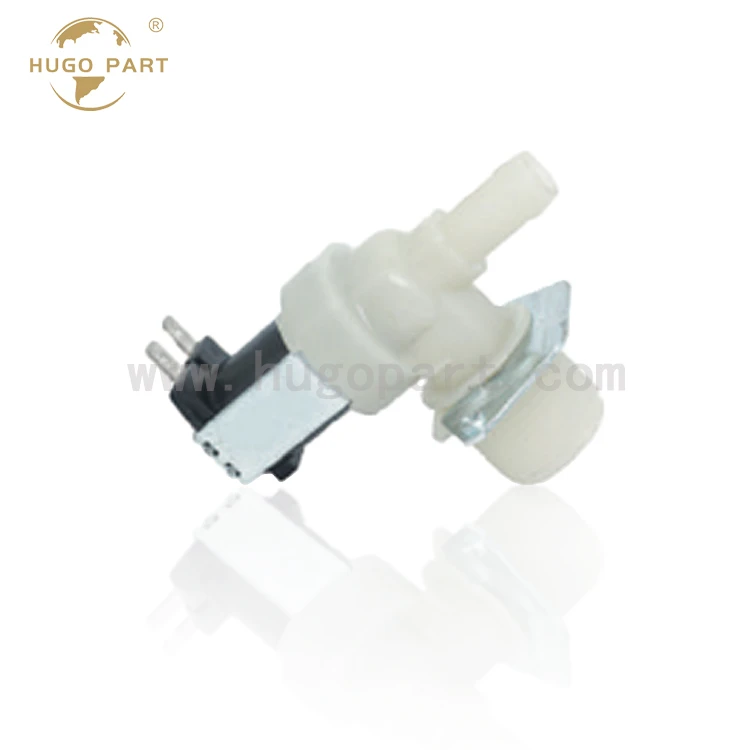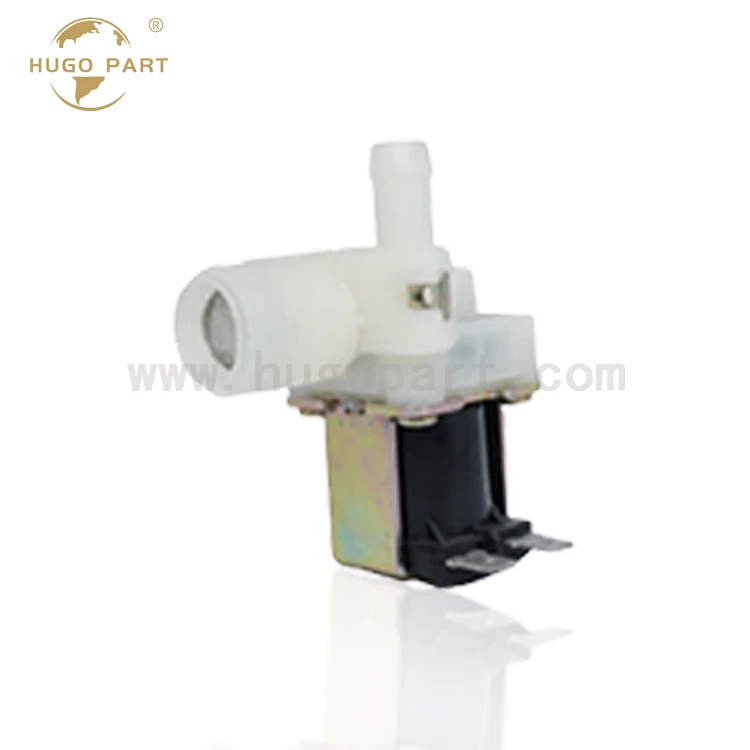
Hugo is a manufacturer and supplier of washing machine water inlet valves in China, supplying single head, double head, and multi way valves to repair channels and complete machine factories. The inlet valve is the part that makes automatic water filling possible, and its reliability shows up in ways customers notice quickly: a slow fill, a drip that never stops, or a machine that will not fill at all. Hugo builds these valves around the four failure points that actually occur in service: coil, diaphragm, filter, and valve core.
The water inlet valve of a washing machine is an automatic water switch that connects the tap water pipe to the inside of the washing machine. It consists of an electromagnetic coil, a valve core, a rubber diaphragm, and a filter screen.
After the computer board sends the water injection command, the coil is powered on to close the valve core, the water circuit is opened, and water flows into the washing bucket through the filter screen. After the water level reaches the set value, the power is cut off, and the spring returns to close the waterway, stopping the inflow of water. The entire process does not require manual switching, and it is the basic component for the washing machine to achieve automatic water filling.
According to the structure, there are commonly three configurations. Matching the valve to the machine type is the first step in choosing a replacement.
Drum models often use double head valves with cold and hot water regulation, while pulsator and semi-automatic models often use single head valves. For wholesale washing machine inlet valve orders, confirming the structure first avoids a valve that fits the pipe but not the program.
To determine if there is a problem with the inlet valve, pay attention to a few specific phenomena. These are the field signals repair technicians use to decide whether the valve needs replacement.
These mostly point to coil burnout, membrane aging and damage, filter blockage, or valve core jamming. Each of these four causes is addressed in the design points below.
It starts with the coil. A high magnetic conductivity pure copper coil gives fast response and low temperature rise. Low temperature rise matters because a coil that runs hot degrades its own insulation over time, and coil burnout is one of the most common inlet valve failures.
The nylon valve body is reinforced with brass inserts for pressure and crack resistance. Water supply pressure varies widely between buildings and regions, and the threaded connections are where cracking usually begins. Brass inserts hold the thread form under pressure better than plastic alone.
The seal is a food grade rubber seal with double O-rings to prevent dripping and leakage. A single O-ring has one line of defense; the double O-ring arrangement covers the case where one ring seats imperfectly against a slightly uneven surface.
The valve is equipped with a stainless steel filter screen to prevent impurities from clogging. Slow water inlet is frequently a filter problem rather than a valve problem, and a stainless steel screen holds up to sediment and grit better than a fine plastic mesh.
Each unit undergoes on/off and pressure holding tests. The on/off test confirms the coil opens and closes the valve on command; the pressure holding test confirms the closed valve does not leak under line pressure. A valve that passes both is the baseline we ship.
It is an automatic water switch between the tap water pipe and the machine. The computer board powers the coil to open the valve core, water flows through the filter screen into the bucket, and when the water level reaches the set value the power is cut and the spring closes the waterway.
No water inlet at all, slow water inlet, continuous dripping when not in use, a buzzing sound but no water entering, and continuous water inlet even when the water level is reached. These mostly point to coil burnout, membrane aging, filter blockage, or valve core jamming.
Drum models often use double head valves with cold and hot water regulation, while pulsator and semi-automatic models often use single head valves. Multi way valves with independent electromagnetic control are used where separate water paths are required.
A high magnetic conductivity pure copper coil, a nylon valve body reinforced with brass inserts, a food grade rubber seal with double O-rings, and a stainless steel filter screen.
Each unit undergoes on/off and pressure holding tests to confirm the valve opens and closes on command and does not leak under line pressure when closed.
Yes. Single head, double head, and multi way valves are supplied to repair channels and complete machine factories. Confirming the valve structure and machine type before ordering keeps the replacement direct-fit.