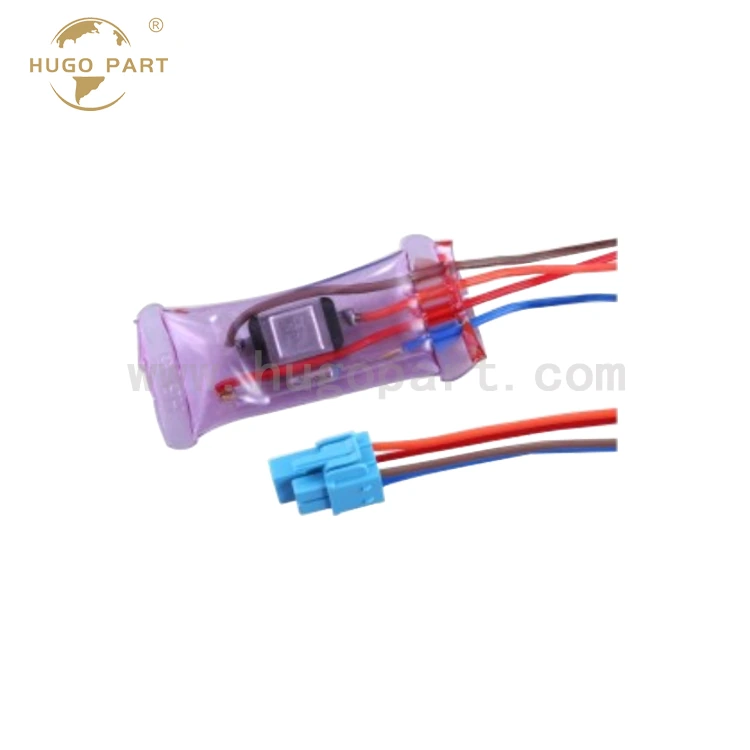
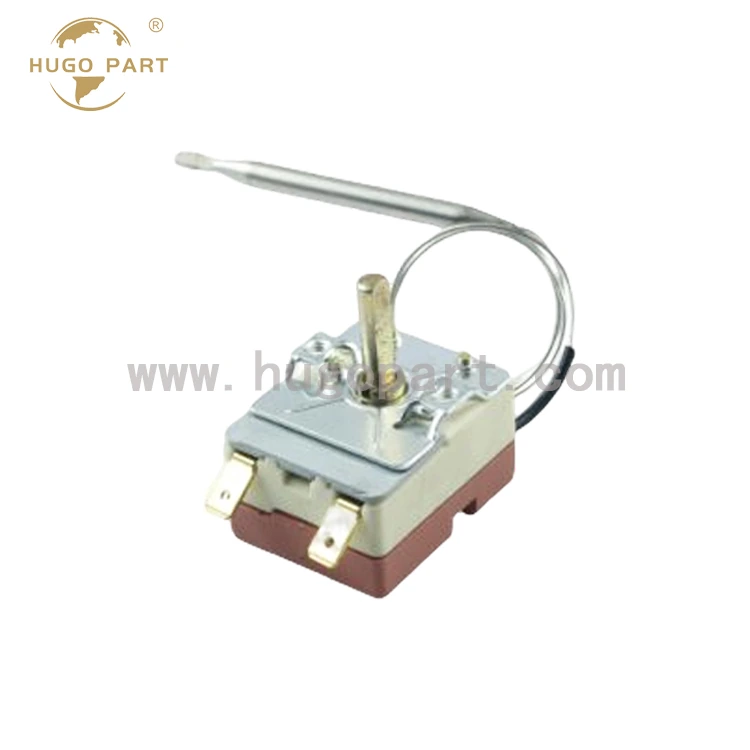
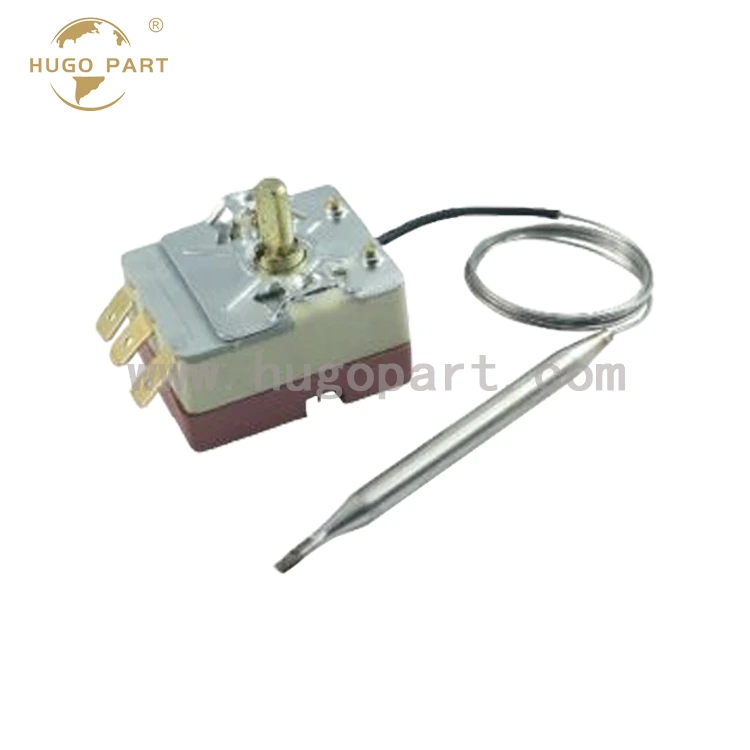
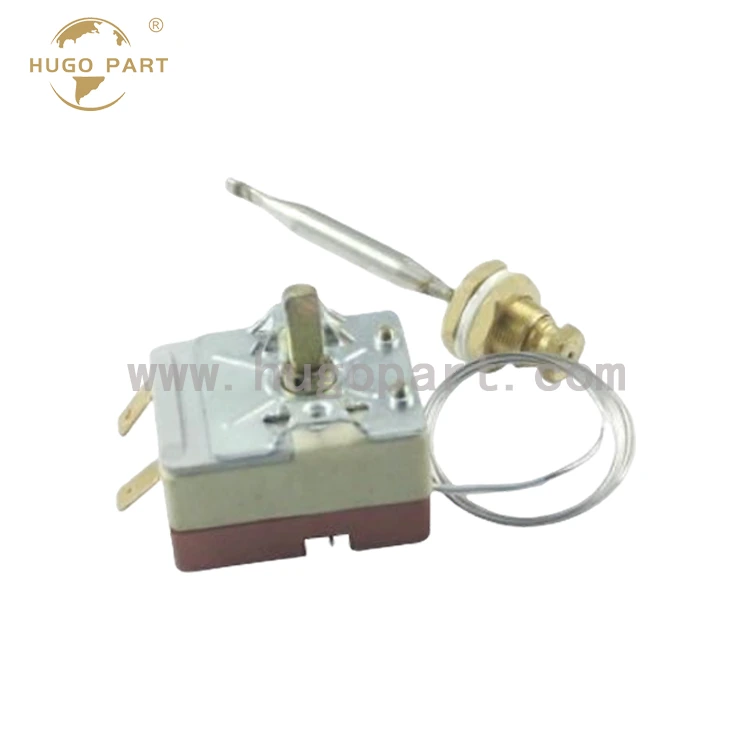
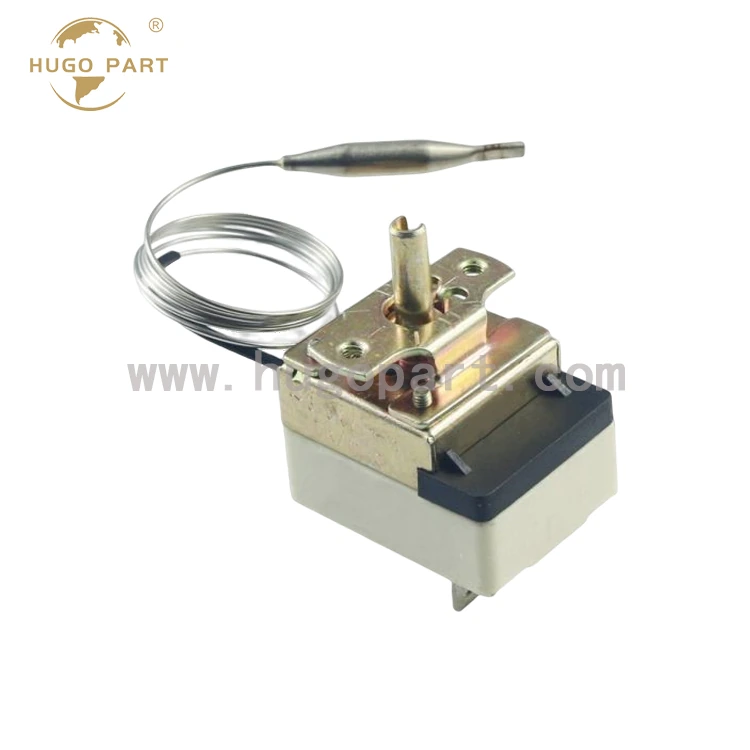
Hugo 2-Pin Refrigerator Thermostat is widely used in household and commercial refrigerators, freezers, and display cabinets as a mechanical temperature controller that regulates the compressor circuit. It is specifically designed to sense the interior temperature through a capillary tube, close the internal contacts to energize the compressor when the temperature rises above the set point, and open them again to stop cooling once the cut-out point is reached. The biggest feature of this thermostat is its precise temperature switching and durable contact structure, ensuring the compressor starts and stops at the right temperature, food stays properly chilled, and the refrigerator runs without continuous operation or repeated cycling.
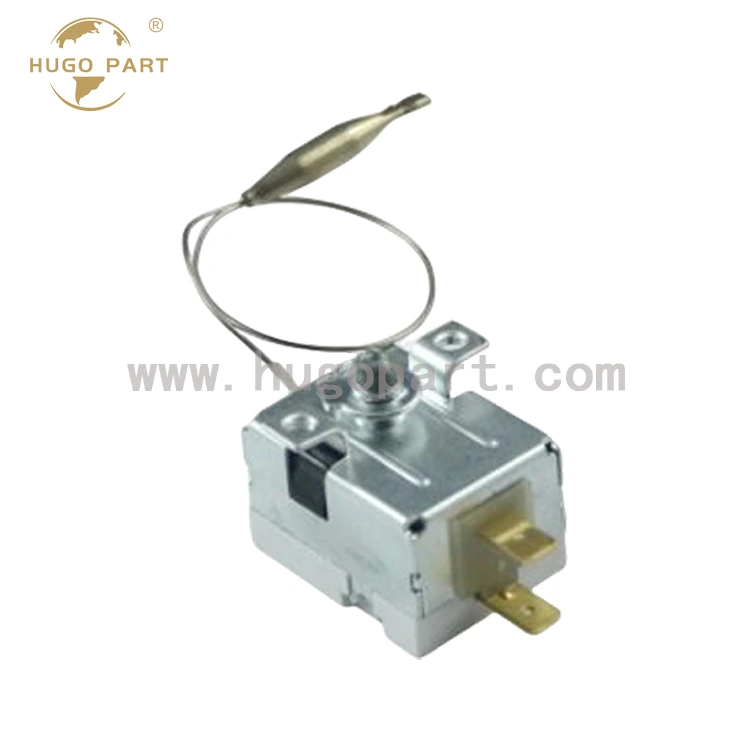
2-pin Refrigerator Thermostat is a mechanical temperature controller for refrigerators, which relies on a temperature sensing capillary tube inserted into the refrigeration compartment or attached to the evaporator to sense temperature changes inside the box. When the temperature exceeds the set point, the internal contacts close and the compressor circuit is connected to start cooling; The temperature drops to the shutdown point, the contacts disconnect, and the compressor stops working. It is essentially a switch that automatically opens and closes according to temperature, with 2-pin terminals in and out, directly connected to the compressor power supply circuit. When the temperature controller is not on time, the refrigerator will not stop, not cool, or frequently start and stop. Simply replace it with a new part that matches the specifications to restore temperature control.
The refrigerator thermostat looks simple, with two needles and a capillary tube, but it is the "main switch" for starting and stopping the compressor. Choosing the wrong one can result in not stopping the machine and consuming electricity, or causing the compressor to burn out. Hugo's 2-pin thermostat is designed around the most common pitfalls in maintenance and machine manufacturing.
Accurate start and stop points, without false markings - each thermostat undergoes a start and stop point calibration before leaving the factory, and switches to the desired temperature based on the markings. Unlike low-priced parts that claim to stop at -18 ℃ but actually stop at -12 ℃, the freezer does not freeze hard and the compressor runs for a few more hours.
Silver alloy contacts, do not ignite when turned on or off - the starting current of the compressor is high, and ordinary contacts may burn or stick after prolonged use, resulting in "unable to stop" or "unable to start". Hugo uses silver alloy contacts, which ensure stable high current on and off, and the contact resistance does not soar for a long time.
Copper capillary tube+sealed temperature sensing package, temperature sensing does not float - the capillary tube is made of copper tube, and the temperature sensing package is sealed, which ensures no leakage, rust, or water vapor in low temperature and high humidity environments for a long time. The temperature response is stable, and the temperature will not be inaccurate after six months of use.
2-pin direct connection, time-saving maintenance - standard 2-pin terminal, directly plugged into the original machine harness without changing the wiring or welding. The repairman disassembles the old and installs the new in a few minutes, and the efficiency of on-site repairs is high.
Full factory inspection, worry free after-sales service - check the starting and stopping points, contact continuity, capillary sealing, and insulation performance of each batch.
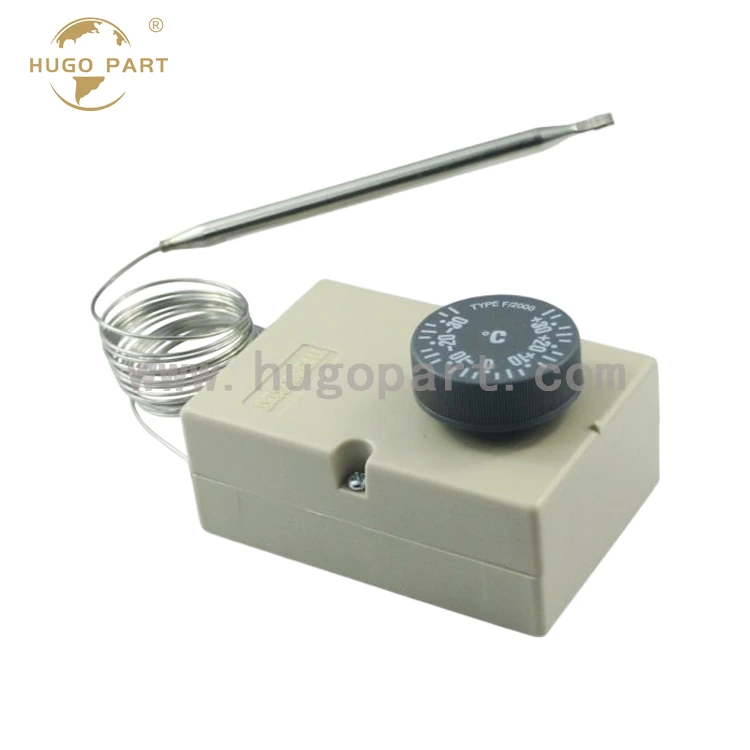
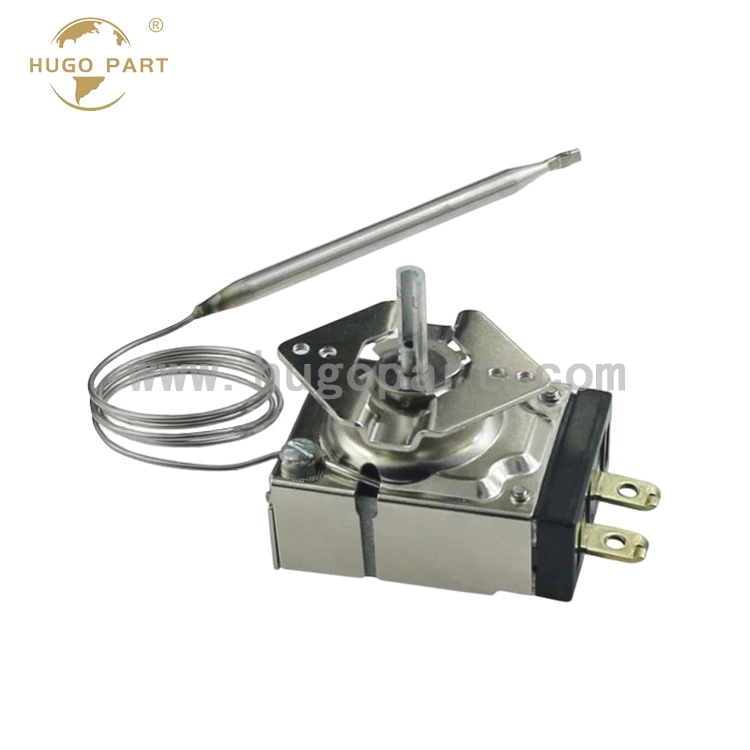
| Product name | 2-Pin Refrigerator Thermostat |
| Available specification | 2-Pin |
| Available colors | Customization is available upon request |
| Samples available | Small quantity samples can be provided; specific details are negotiable |
| MOQ (Minimum Order Quantity) | Negotiable |
| Warranty time | Generally 1 year, except for special cases |
| Packing method | Carton packaging; specific details are negotiable |
| Place of origin | Ningbo, China |
The 2-pin mechanical thermostat is the basic control component of the refrigerator refrigeration circuit. It can be used for any equipment with a compressor that needs to automatically start and stop according to temperature. Hugo mainly covers the following scenarios:
Double door/three door refrigerator: controlling the start and stop of the refrigeration and freezing chamber compressors is the most common replacement scenario.
Single door refrigerators, dormitory refrigerators, and car refrigerators: These models have a simple structure and the highest failure rate of 2-pin temperature controllers.
Air cooled/direct cooled refrigerators: Direct cooled models are more commonly used, with temperature sensing capillary tubes attached to evaporators or temperature sensing inside the box.
Commercial display cabinets, beverage cabinets, cake cabinets: require stable temperature control, as inaccurate temperature controllers directly affect product quality.
Commercial refrigerators and horizontal refrigerators: commonly used in supermarkets and catering kitchens, with a high demand for replacement.
Kitchen workbench, refrigerator, salad table: high-frequency use in the catering industry, temperature controllers are prone to wear and tear.
Small cold storage and fresh-keeping storage: used as compressor start stop control components.
Home appliance repair shop, on-site repair service: always available with universal specifications for quick replacement.
Wholesalers and distributors of home appliance accessories: bulk stocking, covering multiple brand models.
Ice maker: Some models use similar mechanical temperature control.
Common manifestations: The refrigerator does not stop, the compressor keeps running, and the refrigeration compartment freezes or damages food due to freezing; Completely no cooling, compressor does not start; Start stop too frequently, stopping in a few seconds and starting again after a while; There is no response when the temperature adjustment knob is turned; Some models have abnormal defrosting. If these situations occur, first check the thermostat, then check the compressor, starter, and refrigerant.
Two needles are usually connected to the power input (live wire) and the compressor output circuit, which belong to switch on/off type and have no positive or negative polarity. But the needle position must be connected according to the original machine definition. Incorrect connection can cause the thermostat to malfunction or the compressor to become uncontrollable. During installation, match the original machine harness position one by one, insert the locking buckle tightly, and avoid virtual connection and ignition.
Check four items: start stop temperature (such as -2 ℃~8 ℃ for refrigeration, -18 ℃ for freezing, etc.), capillary length, shaft type and knob form, installation hole position and fixing method. Send photos of the old thermostat (front, terminal face, capillary root with ruler) and refrigerator model to Hugo customer service for quick confirmation of compatibility.
Possible reasons: temperature controller specifications do not match, wrong start stop point selection; Capillary tube not inserted properly or temperature sensing bulb detached from evaporator, resulting in temperature distortion; Contact adhesion; The refrigerator door is not tightly sealed and cold air leaks out; Insufficient refrigerant or system blockage leading to slow cooling; The ambient temperature is too high. It is recommended to first confirm the installation position of the capillary tube and the fit of the temperature sensing bulb, and then investigate the refrigeration system.
Not recommended. The length of the capillary tube affects the temperature response speed and the accuracy of the start stop point. Randomly cutting it short can lead to temperature deviation and abnormal start stop. When selecting, the length of the machine should be selected according to the original specifications. If adjustments are necessary, they should be handled by professionals according to the original specifications, and should not be cut by oneself.
The Hugo thermostat uses silver alloy contacts, copper capillary tubes, and sealed temperature sensors, and can be used normally for several years. The following situations will accelerate failure: long-term on-off high current erosion of contacts; Bending, flattening or damage of capillary tubes leading to thermal distortion; Moisture and water ingress in the temperature sensing package; Frequent and forceful twisting of the knob causes wear on the cam. Proper installation and avoidance of excessive bending of capillary tubes can significantly extend their service life.
Address
Dongshantou Industrial Park, Guanhaiwei Town, Cixi City, Ningbo Province, Zhejiang Province, China