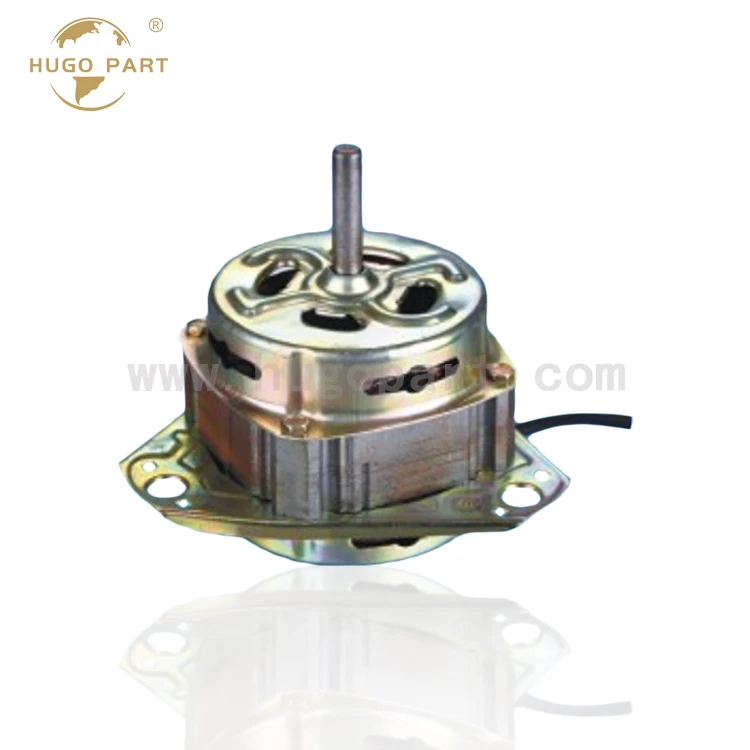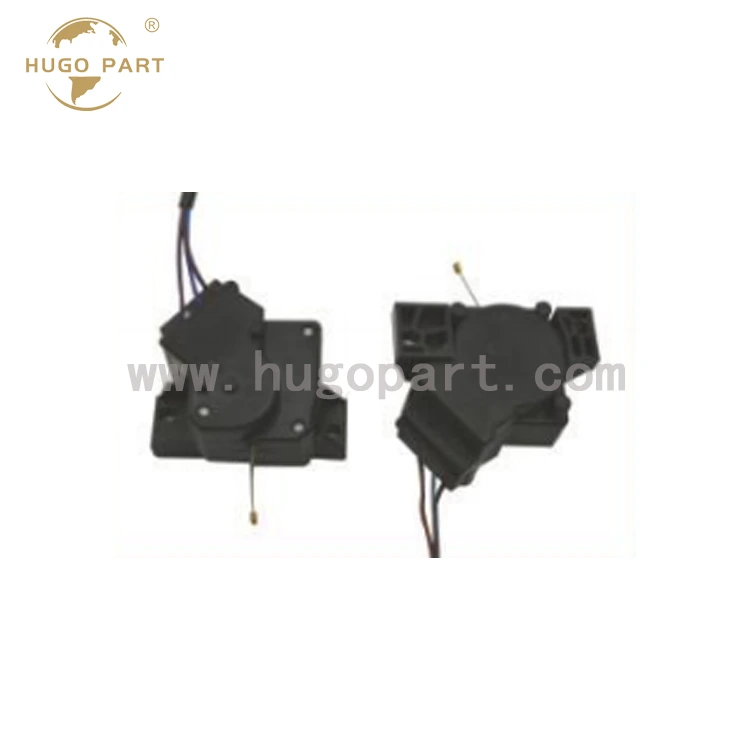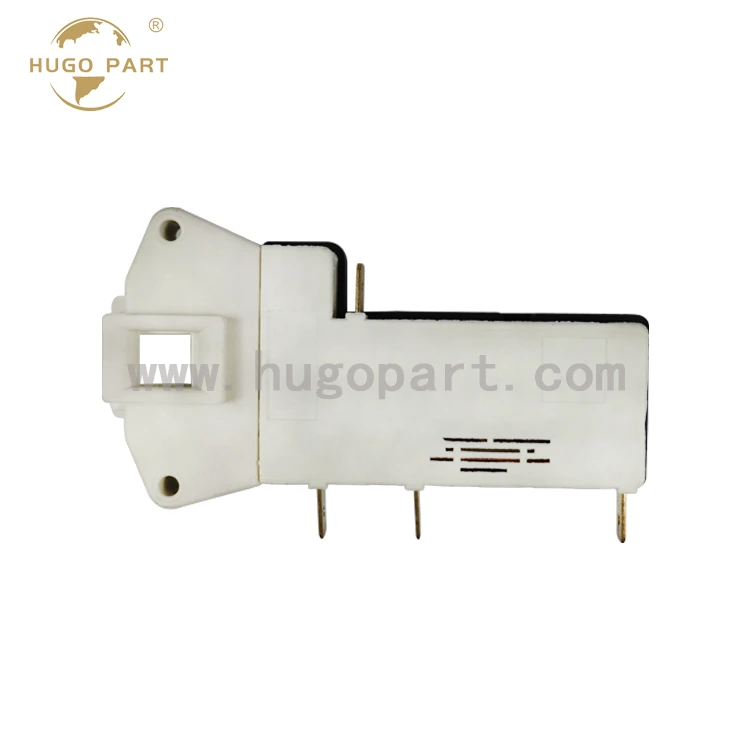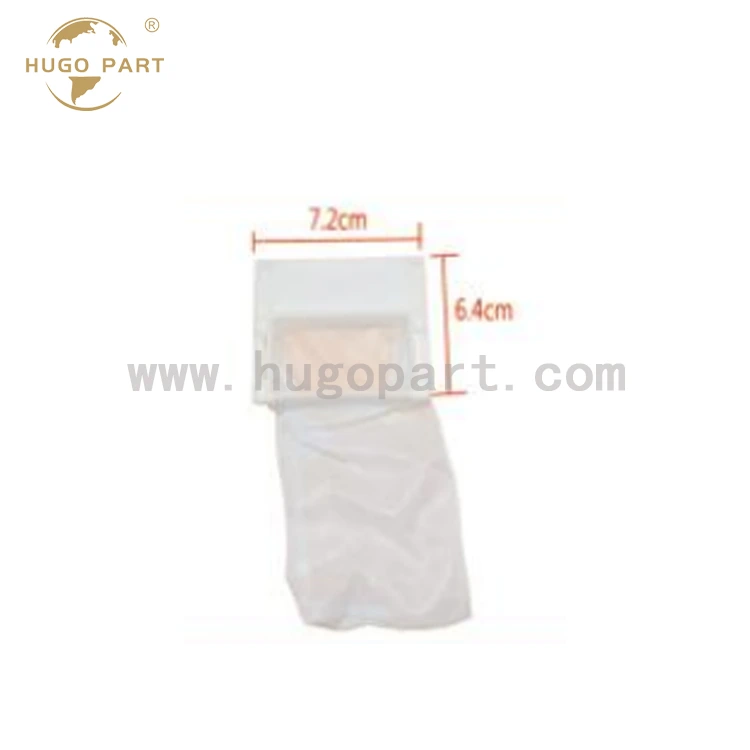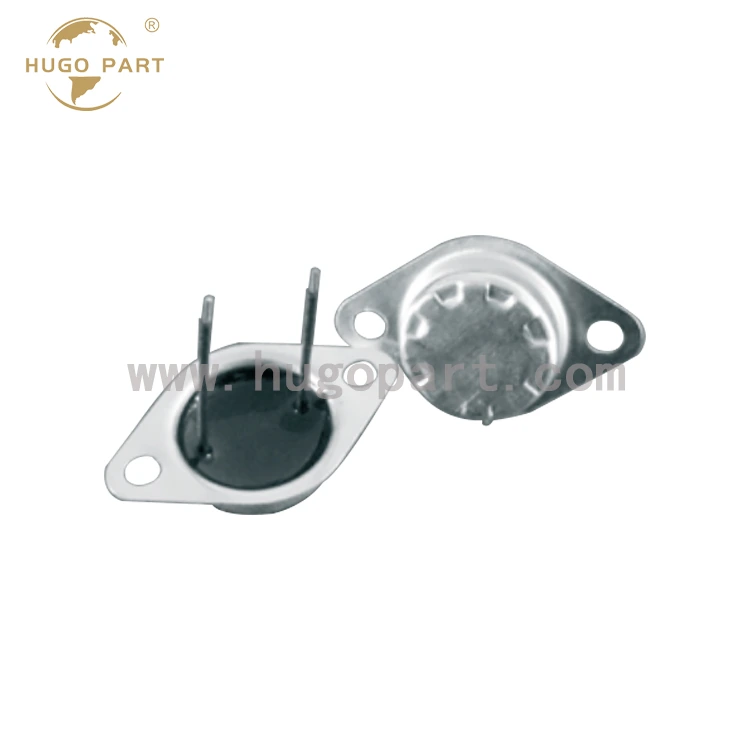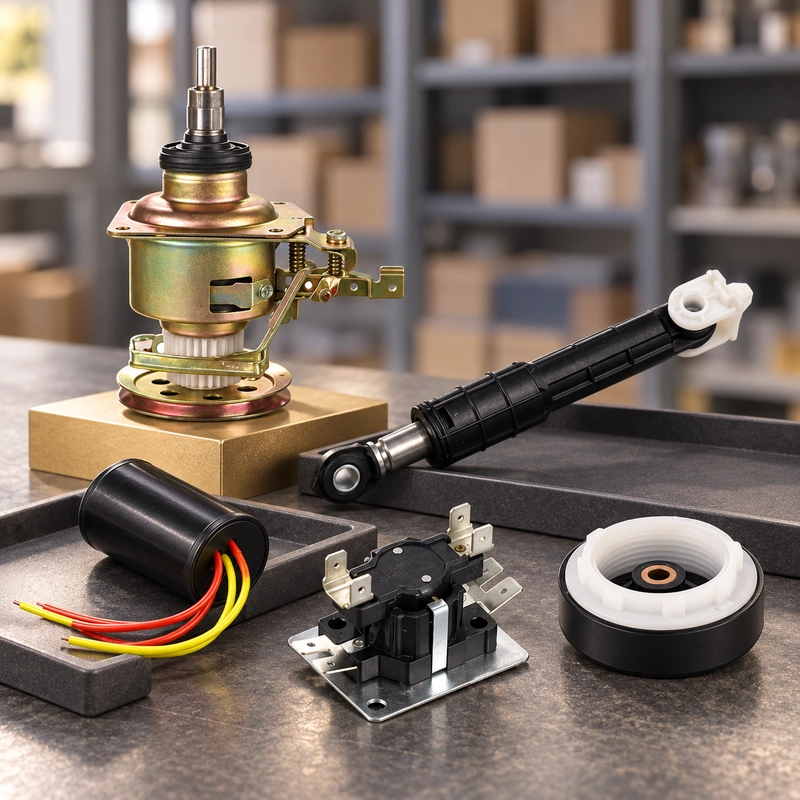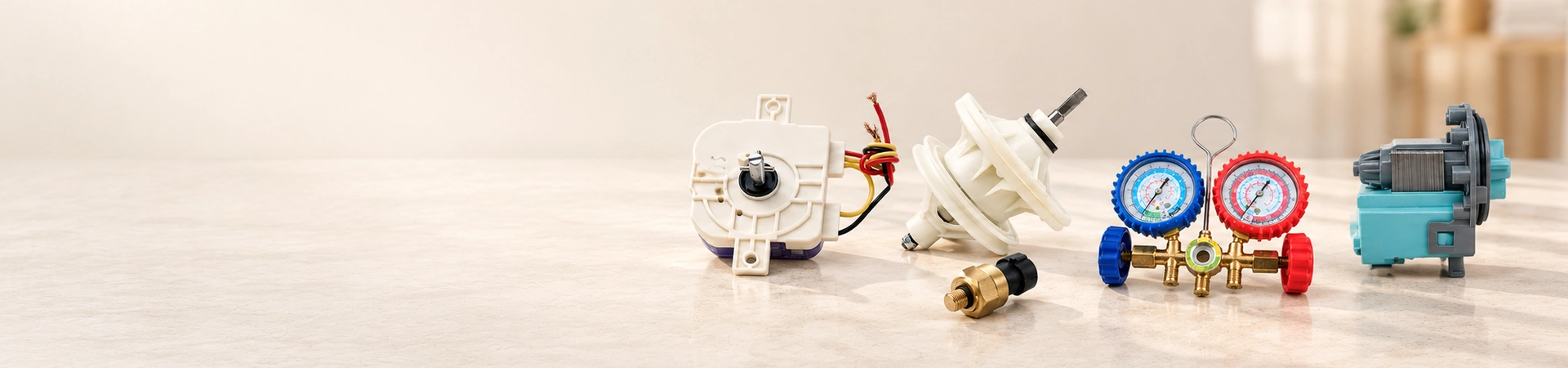
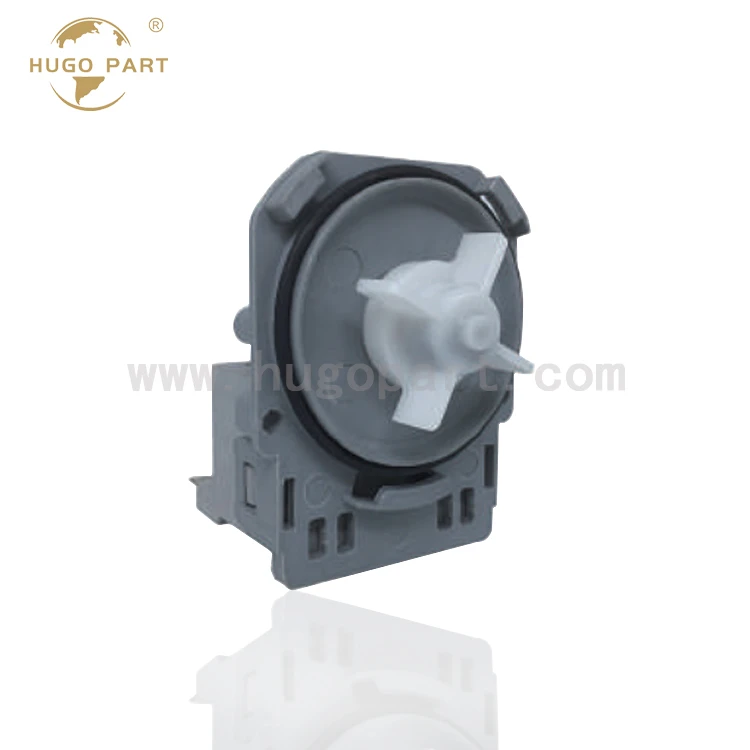
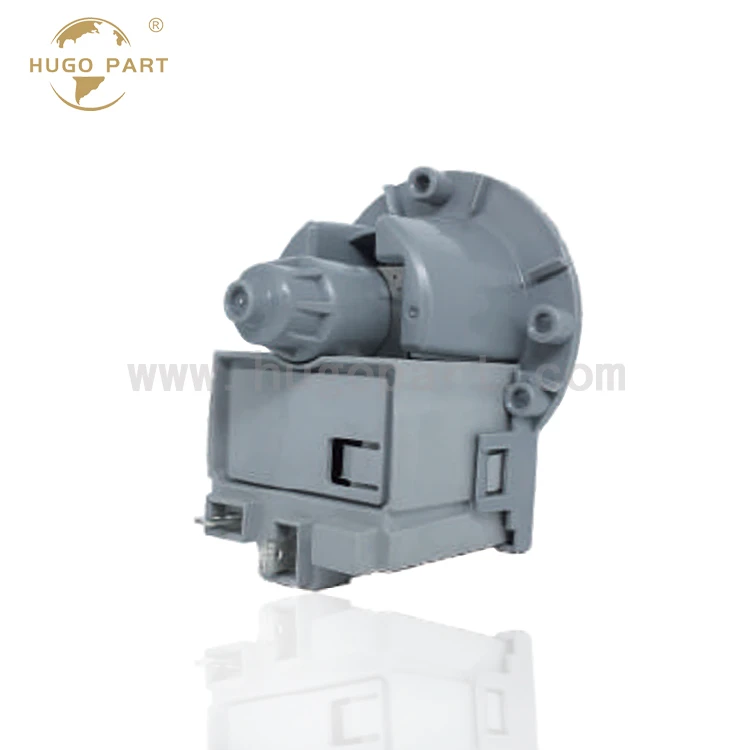
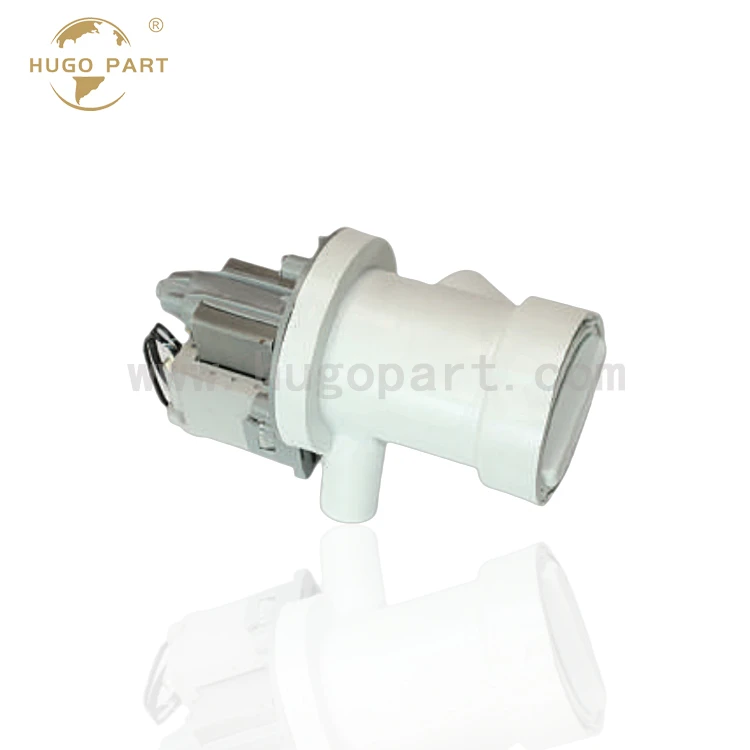
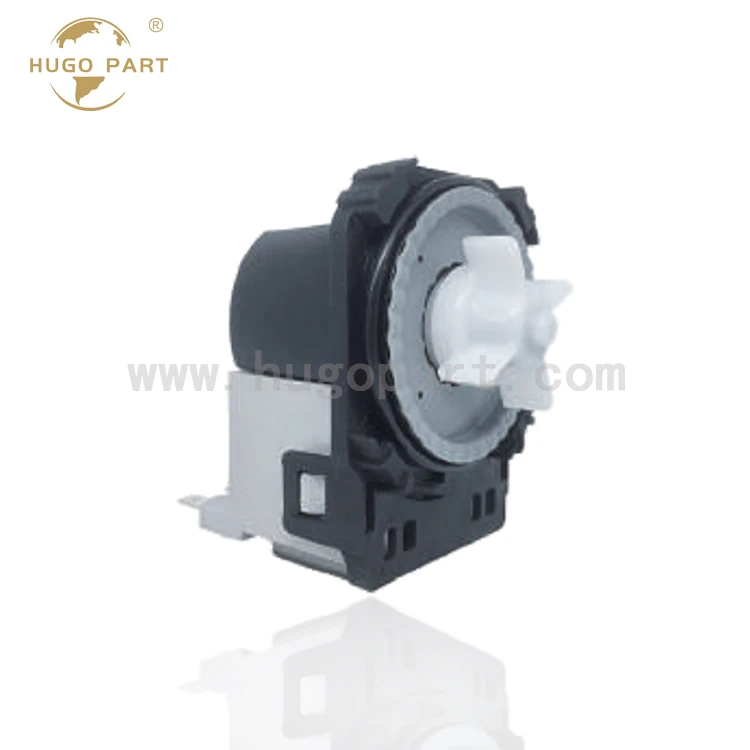
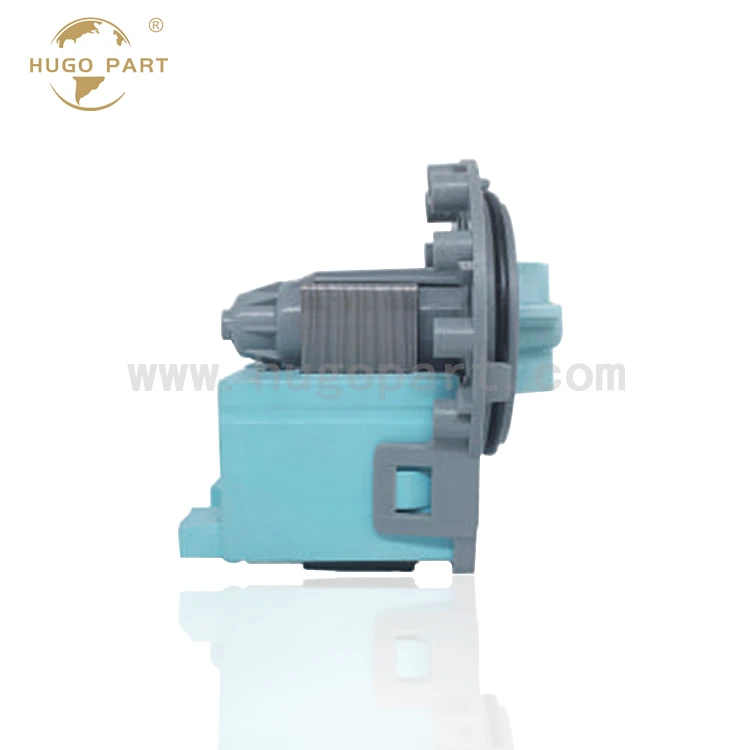
Hugo 20-80W Washing Machine Drain Pump is widely used in semi-automatic twin-tub washing machines, spin dryers, and portable washers for reliable water discharge. It is specifically designed to accommodate different drainage heights, hose lengths, and pump capacities, ensuring seamless integration with the drainage system. There is a high-purity copper wire winding motor inside the pump, combined with a corrosion-resistant pump housing, so that stable pumping performance and long service life can be guaranteed.The biggest feature of this drain pump is its thermal overload protection, and its low noise operation ensures a quiet laundry experience for long-term durability.
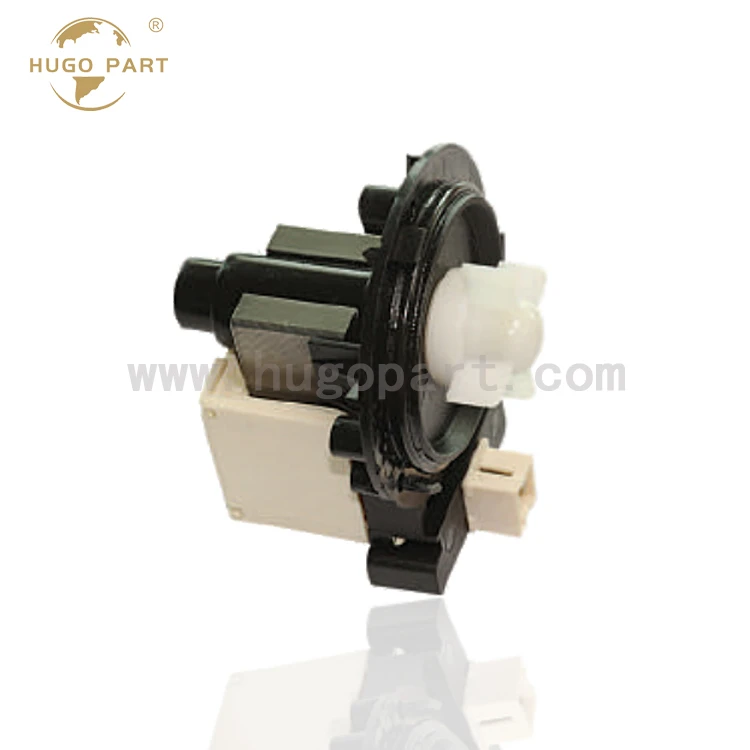
The core task of a drainage pump is to pump out the water from the bucket and discharge it into the sewer. Its working process can be divided into four steps:
After the washing machine enters the drainage program, the timer or control circuit supplies power to the drainage pump. After the coil inside the motor is energized, a magnetic field is generated, which drives the rotor to start rotating.
The motor rotor drives the impeller inside the pump body to rotate at high speed. When the impeller rotates, it generates centrifugal force, which throws water outward from the center of the pump body, forming water flow pressure.
The water thrown out by centrifugal force accelerates along the flow channel of the pump body, is pushed into the drainage pipe from the outlet, and discharged out of the washing machine along the pipe. The impeller continues to rotate, and the water is continuously pumped away until the water level in the bucket drops to the lowest.
After the drainage is completed, the control circuit cuts off the power, the motor stops rotating, the impeller stops rotating, and the drainage process ends.
Three key details:
The drainage height (head) determines the power demand. The drainage pipe needs to lift the water to a certain height to be discharged (such as connecting to a high-level water outlet), and the higher the height, the greater the power required. 20W is suitable for low rise drainage outlets, 40-60W is suitable for regular household use, and 80W is suitable for high lift or long drainage pipes.
Thermal overload protection is a 'safety valve'. If the drainage pipe is blocked, the impeller is stuck, or the motor is blocked, it will cause a surge in current and an increase in temperature. The thermal overload protection device will automatically cut off the circuit to prevent the motor from burning out. After troubleshooting and cooling down, it can be reset and continue to be used.
Sealed bearings are "moisture-proof shields". Long term exposure to water vapor and poor sealing of bearings in drainage pumps can lead to water ingress, rusting, and jamming. The Hugo drainage pump adopts a sealed bearing design to prevent moisture from seeping into the interior of the motor, ensuring smooth rotation and longer service life.
| Product name | 20-80W Washing Machine Drain Pump |
| Available specification | 20-80W |
| Available colors | Customization is available upon request |
| Samples available | Small quantity samples can be provided; specific details are negotiable |
| MOQ (Minimum Order Quantity) | Negotiable |
| Warranty time | Generally 1 year, except for special cases |
| Packing method | Carton packaging; specific details are negotiable |
| Place of origin | Ningbo, China |
The selection of drainage pump is not only based on power, but also on the drainage height, pipe length, interface, and installation space. Otherwise, it will either not drain completely or cannot be installed. Please select according to the following steps:
Measure the vertical drop from the washing machine drain to the final outlet (sewer/bucket/floor drain):
Within a drop of 0.5 meters: 20W is sufficient (portable, mini washing machine, low water level model)
Drop of 0.5-1 meter: 40W, preferred for regular household use
Drop of 1-1.5 meters: 60W is stable, and there is no need to worry about long drainage pipes
Drop of more than 1.5 meters or particularly long drainage pipe: 80W high lift model
Mnemonic: Use 20 for short, 40 for home selection, 60 for high lift, and 80 for super long and super high.
Remove the old pump and measure two quantities:
Inner diameter of drainage pipe: commonly 18mm, 20mm, 22mm, confirm that the outer diameter of the pump outlet can match
Pump body interface form: direct insertion, snap fit, threaded - choose the same structure as the original machine, mixing may cause water leakage or improper installation
Measure the distance between the installation holes of the old pump (center to center distance between two holes) and confirm that the bracket holes are aligned
Confirm the direction of the motor output (left out/right out/rear out) to avoid tightening the wiring harness or interfering with other components after installation
If unsure, take photos of the front and side of the old pump and send the tape measure scale to Hugo's technical team for confirmation within 30 minutes
The longer the drainage pipe and the more bends there are, the greater the water flow resistance. It is recommended to increase the power by one level on the head foundation
For example, if the drop is 0.8 meters but the drainage pipe has 3 bends and a total length of 3 meters, it is recommended to raise it from 40W to 60W
Confirm original voltage: 220V/50Hz (for most models in China, Southeast Asia, the Middle East, and Europe) or 110V/60Hz (for some models in the United States, Japan, and Taiwan)
If the voltage is not correct, directly burn the motor. Before placing an order, be sure to confirm the nameplate or take a photo of the old motor nameplate
Drainage pump failures usually manifest as: no drainage or slow drainage, abnormal noise or buzzing during drainage but no drainage, severe motor heating, and a large amount of accumulated water in the bucket after drainage. If the above situation occurs, it is recommended to first check whether the drainage pipe is blocked, whether the drainage pipe is bent or flattened, and then determine whether it is a drainage pump fault after troubleshooting. In addition, long-term use of drainage pumps in humid environments can accelerate the aging of internal components, and regular inspections can detect potential hazards in advance.
The power selection mainly depends on the drainage height (head) and the length of the drainage pipe. The higher the power, the better. Excessive power may generate noise and additional energy consumption. Choose the most suitable option based on the original machine power or actual drainage conditions. Remove the old pump and check the nameplate power, or take a photo of the nameplate and send it to Hugo customer service for confirmation.
The Hugo drainage pump adopts high-purity copper wire winding, sealed bearings, and corrosion-resistant shell. But the following situations can accelerate damage: blockage of the drainage pipe causing the motor to stall and heat up for a long time, unstable voltage and frequent start stop, long-term immersion in water, and rusting of bearings due to water ingress. Proper use and regular cleaning of drainage pipe filters can significantly extend their service life.
Not necessarily. The common reasons for slow drainage are: foreign objects blocking the drainage pipe (coins, buttons, wire scraps), bent and flattened drainage pipes, high drainage height exceeding the pump head, and foreign objects stuck in the impeller. It is recommended to first remove the drainage pipe for inspection and dredging, then check if the impeller is stuck, and finally consider the pump body issue. If the pump is running normally but the drainage is weak, it may be due to impeller wear or internal seal failure, and the drainage pump needs to be replaced.
A slight buzzing sound during the operation of the drainage pump is a normal phenomenon. If the noise significantly increases, possible reasons may include foreign objects getting stuck in the impeller, bearing wear, loose installation screws, and resonance in the drainage pipe. First check if the drainage pipe is blocked by foreign objects, and then confirm if the fixing screws of the pump body are tightened. If the noise persists and is accompanied by weak drainage, it is recommended to dismantle the machine and check the condition of the impeller and bearings.
Address
Dongshantou Industrial Park, Guanhaiwei Town, Cixi City, Ningbo Province, Zhejiang Province, China